Welcome to our two-part blog series on “ALPS Content Simulation.” In this series, we will discuss ways to optimize your existing content and create new content from scratch using the ALPS Content Simulation tool.
However, in this blog, we will solely focus on how to use the Content Simulation tool to optimize your existing content for performance improvements.
Let’s begin!
ALPS Content Simulation is much more than just a tool. It’s your content’s best friend.
So, where to begin?
Right here, with this ALPS Content Simulation getting started guide.
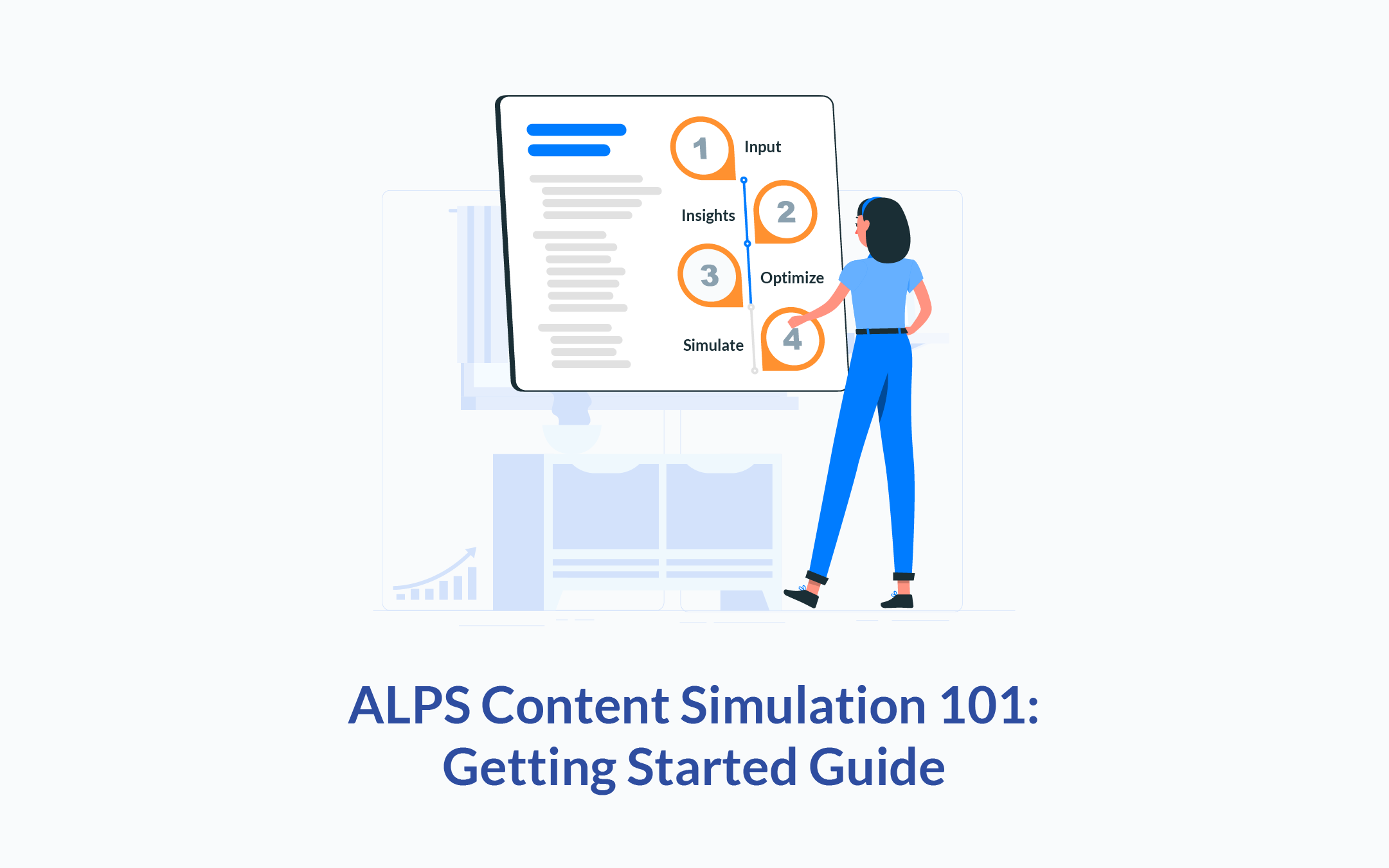
Irrespective of the shape or size of your content goals, the process of using our Content Simulation tool should look something like this:
Input
Insights
Optimize
Simulate
You can input the target URL and the keywords, get insights into your current performance against the top 10 ranking competitors, optimize your content using automated improvement recommendations, and simulate your content versions to predict the performance impact even before publishing the changes.
Now, let’s show you how to input your target URL and keywords, get insights, optimize, and simulate your content with Content Simulation.
Step 1: Input your target URL and Keywords
Accessing the Tool: Log in to your ALPS account and navigate to the Page Simulation tool in the optimization tool menu.
Choosing the Locale: Choose the demographic you want to target.
Target URL: Enter the webpage URL you want to analyze and optimize.
Keyword Selection: Choose your target keywords or phrases (up to 5) for which you want to optimize your content.
Once you have entered all the required fields, click “Go.”
Step 2: Get insights into your current performance
Page Assessment: ALPS Content Simulation dives deep into your on-page and off-page SEO for the target URL, giving you an overview of how your webpage is performing in key SEO metrics like content, authority, and technical.
Competitive Analysis: Gain a competitive edge against your competitors with these focused insights:
Score Gap Analysis: Find where you’re lagging behind the competition. With our proprietary scoring, quickly analyze where you stand against the top 10 competitors for content, authority, and technical SEO.
Competitor Content Outline: Gain a clear view of your top 10 competitor’s content structure. With our easy-to-understand scoring, benchmark your page’s content performance against top competitors for key content aspects like URL, Title, Meta, H1, H2, H3, Body Content, and Readability grade.
Backlink Summary: Get an overview of the performance of the backlink profiles and know the authority scores for the target page and the top 10 competitor pages. Analyze key authority parameters like backlink quantity, backlink quality, domain authority, and backlink relevance.
Core Web Vitals: Analyze critical user experience metrics like loading speed, interactivity, and visual stability. You can use ALPS scores to analyze the technical performance and the Core Web Vitals (CWV) like Largest Contentful Paint (sec), First Input Delay (ms), Cumulative Layout Shift, Time To First Byte (sec), and much more for both the target URL and the top 10 competitors.
Step 3: Drive predictable SEO gains with AI-driven optimization
Visual cues: Based on the ALPS analysis, get visual cues (red, orange, green bulbs) to quickly identify how relevant your content is to the target keywords. This allows you to understand which aspects of your page content need immediate improvement.
Content improvements: Get AI-driven improvement recommendations to optimize your content’s URL, Title, Meta tags, Headings, and Body content. You can generate automated content suggestions and use them directly in the editor.
Competitive Analysis: Get to know the exact content (Titles, Meta, etc.) used in the top 10 competitor pages and their relevance scores for the target keyword/s.
Phrase Usage: Know the usage of the keyword phrases and the frequency of those phrases in the competitor pages.
Step 4: Simulate content versions to identify the highest-performing version
Simulate: Consider ALPS Content Simulation as a sandbox for testing and optimizing your pages. Test your content based on different optimization ideas to choose the one that creates maximum performance impact.
In the Editor screen, just go to the content you would like to optimize (Title, Meta, Headings, etc.), change the current content with the new version, and click ‘Update Score and Predicted Rank’ to simulate and find the best version.
Final Thoughts
So, now you know how to optimize your content to maximize the content’s performance.
Still doubtful? Start using the ALPS Content Simulation tool with a 7-day free trial to maximize your content’s performance for SEO.
In the next blog, we’ll learn how to create your content from scratch using the ALPS Content Simulation tool.
A Writers Guide To Generate Unique Content With ChatGPT
Are you tired of gazing at a blank screen, desperately looking for inspiration for your next piece of unique content? Enter ChatGPT, that claims to revolutionize how content writers create content.
But does it really deliver on its promises?
With its proficiency in generating text based on prompts and engaging in interactive conversations, ChatGPT has sparked a lively debate among writers and creatives.
As a professional content writer, I’ll share my experience using ChatGPT in this article and find out whether it can really produce unique and engaging content for readers. We’ll also look at a real-life example to understand how we can use ChatGPT to create content loved by both search engines and human readers.
Let’s find out!
First thing first…
What makes any content unique, and why is it important?
As a content writer myself, I understand the need to create unique and original content when it comes to capturing audience’s attention and standing out from the crowd.
But what makes our content unique?
Well, it goes beyond just avoiding plagiarism. From my experience, I can conclude that true uniqueness comes from distinct voices, ideas, and perspective.
But it’s not enough to just be different; our content must also address the intent of our audience. By understanding their needs, we can tailor our content to provide genuine value and address their specific pain points.
Unique and intent-based content is relevant, trustworthy, and stands out from the noise. Remember, uniqueness lies in combining our authentic voice, original ideas, and meeting the needs of the audience.
Now, to understand whether generative AI tools like ChatGPT can really help create unique content, let’s first know how ChatGPT generates content.
So, how does ChatGPT generate content?
ChatGPT generates content through a combination of algorithms and a deep learning technique called Transformer architecture. It analyzes patterns in a vast dataset from diverse sources like eBooks, websites, articles, etc., and learns to predict and generate coherent responses. The training process involves exposing the model to extensive text, enabling it to grasp grammar, vocabulary, and context.
As a result, ChatGPT becomes a virtual assistant that can produce text resembling a human-like conversation.
Limitations of ChatGPT in creating unique content?
While ChatGPT’s AI language model is incredibly advanced, it’s not infallible. Here are a few of its limitations and biases that I experienced:
The challenge of context: It might struggle with understanding nuanced contexts and generate content that doesn’t align with the intended message.
Biases in training data: AI models learn from vast data sets, which can inadvertently include biases in the text. This can lead to biased or skewed outputs that need careful consideration.
Lack of human experiences: It lacks real-life experiences, emotions, and personal perspectives, which can result in a lack of depth and authenticity in the content it generates.
Over-reliance on prompts: The quality of the output heavily depends on the quality of the prompts. Insufficient or ambiguous prompts result in less satisfactory outputs.
Outdated datasets: It lacks awareness of the latest context and developments beyond 2019. This can hinder its ability to provide up-to-date and accurate information, making it necessary to verify and supplement its responses with current sources.
Caveat for Writers
Potential long-term detriment to our writing skills: Relying solely on the AI model can lead to neglecting the practice and development of our own writing abilities, which are essential for personal growth and developing a unique voice.
Benefits and considerations of using ChatGPT in content creation
Benefits
ChatGPT offers direct benefits like:
Saves time and increases productivity: It acts as our brainstorming partner, quickly generating a number of fresh ideas and saving hours of research and deliberation.
Overcomes writer’s block: Itprovides invaluable assistance by offering new perspectives and nudging our imagination in the right direction.
Boosts efficiency: Itcan streamline our content creation workflow, which allows us to devote more time to refining and polishing our ideas instead of getting stuck in the ideation phase.
Improves productivity: Lets us create more content in less time. It can become our trusted collaborator, empowering us to meet deadlines and exceed expectations.
Considerations
While ChatGPT offers a wealth of possibilities, it cannot replace the unique voice and perspectives that only we writers can bring. Here are a few considerations to remember before generating content with ChatGPT:
Quality assurance: Check for content quality and facts. Eliminate any errors or inconsistencies.
Personalization: Inject personal touch to the content to add authenticity and resonate with the audiences on a deeper level, fostering engagement and connection.
Human creativity: AI-generated drafts can serve as a starting point, but it’s the human touch that adds flair, innovation, and twists.
Avoiding homogeneity: By injecting unique perspectives, break away from the risk of producing cookie-cutter content that lacks originality.
Tailored messaging: Understand the nuances of the target audience, adapting tone, language, and cultural references to create a personalized experience.
How to use ChatGPT to create unique content?
Today, there are multiple contents out there that give us prompts to use ChatGPT for content creation. For sure, you must have read a few as well.
But are they really worth it?
Let’s talk facts!
Let’s look at an example here, where we try to decode how ChatGPT can help us create better and more sophisticated content for our audience.
So, let’s try and generate content using ChatGPT on “How to create unique content for SEO?”
Version 1 prompt: Write a 100 word article on the topic: How to create unique content for SEO?
The result:
Version 1
Now let’s try a more advanced prompt.
Version 2 prompt: Imagine you are a content writing expert. Write an opinionated 100 word article on the topic: How to create unique content for SEO?
The result:
Version 2
Similarly, you can use other prompts like:
“Write a blog post on the topic: How to create unique content for SEO? Write it in a professional tone. Use transition words. Write over 100 words. Include the following keywords: SEO, content.”
Or
“Write a 100-word blog post about: How to create unique content for SEO. Include the following keywords in the headline, subheading, and body paragraphs. Keywords: SEO, content.”
These prompt engineering techniques above can help you create better content, but the question still remains: Is the content unique?
Now let’s try to edit the content with human touch, adding a flair of facts, figures, and creativity.
Version 3
Did you know that high-quality, relevant content is Google’s top ranking factor? Also, according to Hubspot’s State of Marketing 2023 reveals, 83% of marketers believe creating higher quality content is more effective. Therefore, to rank high on the SERPs and stand out from the crowd, you need to break free from the generic cookie-cutter approaches. Inject your own writing style with personality, offering a new perspective that focuses on solving the audience’s challenges. Moreover, studies show that engaging content with a conversational tone boosts reader interaction. Dive deep into your niche, unearthing untapped insights that others often overlook. Don’t shy away from taking risks or pushing boundaries; true uniqueness lies there.
The Analysis
Version 1 vs Version 2
Here are a few findings I can conclude from the results:
Opinionated approach: While Version 1 lacks a clear perspective, making it more generic, Version 2 takes an opinionated stance, adding a distinct flavor and engaging readers.
Challenging prevailing notions: Version 2 encourages readers to question established ideas and think critically. This approach sparks curiosity and promotes active engagement, unlike Version 1, which simply provides tips without challenging existing norms.
Personality and uniqueness:Version 2 emphasizes injecting personality into writing, giving it a human touch and making it more relatable and resonating on a deeper level. In contrast, Version 2 lacks a personal touch, making it feel more mechanical and generic.
Conversational tone:Version 2 adopts a more conversational tone that fosters a connection with the readers. This approach makes it more approachable and enjoyable to read. While, Version 1 lacks a conversational element, making it dry and impersonal.
Risk-taking and boundary-pushing: While Version 1 lacks the emphasis on the importance of experimentation and risk-taking, potentially leading to safer, less impactful content, Version 2 encourages taking risks and pushing boundaries to achieve uniqueness. This mindset drives innovation and helps content creators think outside the box.
Version 3 vs Version 1 and 2
Statistical evidence:Version 3 incorporates statistics like Google’s top ranking factor and the belief of 83% of marketers, adding credibility and factual support to the content.
Industry insights:Version 3 references Hubspot’s State of Marketing report, demonstrating up-to-date knowledge and incorporating relevant industry insights.
Problem-solving focus:Version 3 highlights the importance of offering solutions to the audience’s challenges, aligning the content with their needs, and increasing its value.
Reader interaction:Version 3 mentions the boost in reader interaction that comes with a conversational tone, reinforcing the importance of engaging with the audience.
Attention-grabbing introduction:Version 3 starts with a question, immediately capturing the reader’s attention and setting a tone of curiosity and intrigue.
Final Thoughts
While ChatGPT is good at generating ideas, it lacks the human touch necessary for infusing authenticity and originality into the content. Crafting unique content demands human input and creativity, which ChatGPT lacks.
Imagine multiple content writers relying heavily on ChatGPT to create content on a popular topic. The result? An abundance of similar, generic articles flooding the digital landscape. To stand out, it’s crucial to include personal style and authenticity.
Human input and creativity are key in refining and customizing the ChatGPT-generated content. By leveraging unique perspectives, you can tailor the drafts, writing them with your personal style and voice. This collaboration between your own creativity and machines like ChatGPT enables the creation of content that resonates with your target audience and captures their attention.
About ALPS
ALPS is a leading enterprise SEO platform that transforms how enterprises do their organic marketing. ALPS is built to solve critical SEO challenges like unpredictability, complexity, and high time to results with data-driven insights and the ability to predict the performance impact before committing to changes. ALPS is powered by sophisticated AI technology that reverse engineers Google’s algorithm to make SEO more agile, efficient, and predictable for enterprises. Additionally, ALPS offers dedicated client support and service packs designed to fill competency gaps in any SEO team.
ALPS Update: Now Generate Key Content Elements (Title, Meta, H1, H2, H3) within ALPS
Are you struggling to come up with SEO-optimized titles, meta, and headings? Well, worry no more! ALPS has recently launched an exciting new update that’s about to change the content creation game.
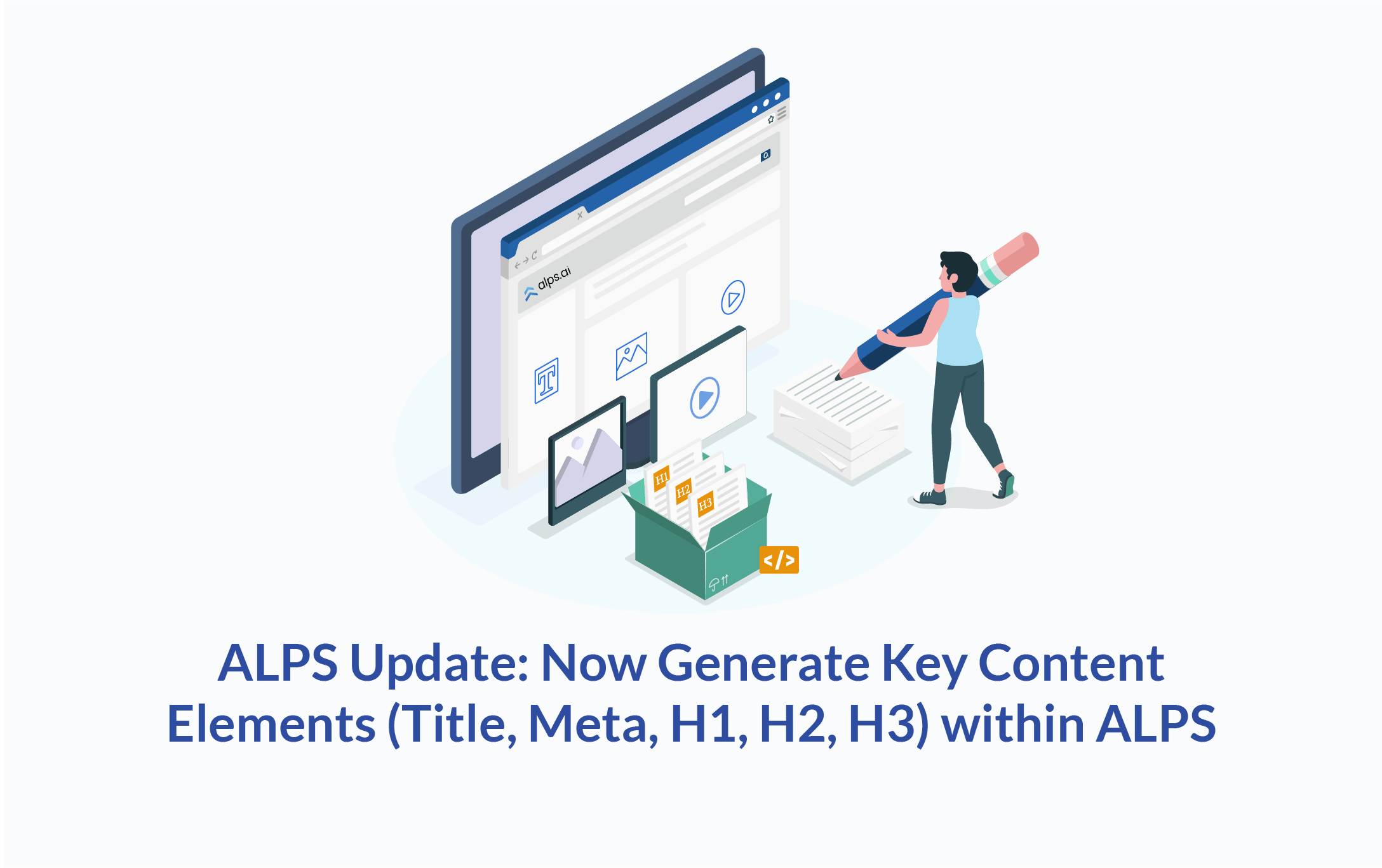
Now, you can effortlessly generate SEO-optimized content for the most important aspects of your content: the titles, meta descriptions, H1s, H2s, and H3s.
Just choose your most preferred keyword and let ALPS’ generative AI do the work for you. No more writer’s block – say hello to stress-free content creation.
About our latest update
At ALPS, we have always been committed to listening to our user feedback and incorporating the most sought-after features.
We are thrilled to introduce you to our latest update that takes your content to new heights.
In our Content Simulation tool, we have gone beyond just providing improvement recommendations and taken a giant leap forward by generating actual content for you based on your keyword preferences.
Imagine this: you have a few preferred keywords in mind and want to optimize your content around it. With ALPS’ latest update, you can now achieve that seamlessly.
ALPS uses generative AI to analyze your chosen keywords and generate content ideas for various elements of your content, like the title, meta description, and headers (H1, H2, H3).
This means you have several optimized options to choose from to improve your content for both search engines and your target audience.
You can now confidently choose the best title, meta description, and headers that align with your keyword and resonate with your target audience.
We aim to improve not only the efficiency of your content creation process but also the quality of your final output.
With ALPS’ latest update, you have the power to supercharge your content optimization efforts and quickly create impactful, SEO-friendly content that drives results.
Start by choosing the content you want to optimize or rewrite. In this case we will try to rewrite the page title for our target keywords using ALPS.
Next click on “optimize.”
Upon clicking “optimize,” the tool will open a new screen to let you choose the preferred keywords among your pre-selected keywords for the content you are trying to rewrite/optimize.
In this case we chose “debt consolidation” keyword for our title.
Post choosing your preferred keyword, click on “Generate Title Recommendations.”
Now you can see all the recommended titles for your preferred keyword choice.
Note: Feel free to regenerate the recommendations in case they don’t match your expectations.
Next, you can select any option from the recommendations and click on “Add to Editor.”
The chosen content will replace the existing content you had directly to the editor.
The result:
Follow the same process to generate recommendations for other aspects of your webpage content (meta, H1, H2, H3)
Conclusion
ALPS’ latest update can be a game-changer for content creators.
From providing improvement recommendations to generating relevant content, we’ve transformed how you optimize the most important aspects of your content.
Why settle for mediocrity when you can access a plethora of ideas tailored to outperform your competitors for the target keywords?
Still skeptical?
Try our free content simulation tool and optimize your content effortlessly. Just put in your work email id and get instant access. No credit card needed!
About ALPS
ALPS is a leading enterprise SEO platform that transforms how enterprises do their organic marketing. ALPS is built to solve critical SEO challenges like unpredictability, complexity, and high time to results with data-driven insights and the ability to predict the performance impact before committing to changes. ALPS is powered by sophisticated AI technology that reverse engineers Google’s algorithm to make SEO more agile, efficient, and predictable for enterprises. Additionally, ALPS offers dedicated client support and service packs designed to fill competency gaps in any SEO team.
Our 6 Step Approach to Solve Biggest SEO Content Challenges
Are you struggling to crack the code of SEO content? If you’re a digital marketer, business owner, content creator, or SEO enthusiast striving to create high-performing content, this guide is tailor-made for you.
Packed with practical insights and actionable tips, this comprehensive guide unveils the steps to conquering two of the biggest SEO content challenges:
Creating SEO-optimized copy that performs well organically
Building authority
To get the most out of this guide, approach it as a roadmap to navigate the ever-changing digital landscape.
By the end of this guide, you’ll be armed with the strategies and tactics to create content that performs well organically and resonates with your target audience.
However, it is important to note that creating SEO-optimized content and building authority cannot be dealt with in isolation.
For example:
Scenario 1: If you only try to build authority without paying enough attention to creating SEO-optimized content, it is evident your content won’t rank high on the Search Engine Result Pages (SERPs).
Similarly,
Scenario 2: If you only create SEO-optimized content but don’t pay enough attention to authority building measures like syndication, or guest posting, you won’t achieve desired results either.
While high-quality content is crucial for SEO success, it alone won’t guarantee desired results.
Factors like keyword or topic research, website structure, user experience, backlinks, and social signals play a vital role in determining search engine rankings and attracting organic traffic.
Even the most brilliant content may struggle to rank well and reach the intended audience.
It will take a comprehensive SEO content strategy that goes beyond just words to ensure maximum visibility and engagement.
Therefore, you need a complete framework to deal with these SEO content challenges for long-term gains.
At ALPS, you have developed a 6 Step Approach to make sure that every content that goes out there on the internet performs well organically.
Step 1: Topic Research
Step 2: Content Structure
Step 3: Content Creation
Step 4: Content Optimization
Step 5: Building Authority
Step 6: Content Performance Measurement
Let’s dig in!
Step 1: Topic Research
First thing first,
Why do we say Topic research and not Keyword research?
The continuous evolution of Google’s search algorithms, like the Hummingbird update (2013), RankBrain update (2015), and Helpful Content update (2022), prompted the shift from merely targeting keywords to understanding the broader context of user intent and interests.
This shift prompted the need for a more holistic approach known as topic research.
Topics help you organize information, but keywords don’t. Keywords reveal different words or phrases used to search for the same result but don’t necessarily capture the semantic relationship like topics.
By focusing on topics, you transcend the limitations of keywords and tap into the vast realm of possibilities.
But what happens when you don’t focus enough on topic research and rely solely on keywords?
By focusing solely on keywords, you risk becoming robots, churning out soulless content that fails to connect with real people.
Without understanding the audience’s needs, interests, and pain points, you’re just shooting in the dark. You might rank high in search results, but will anyone actually care?
Let’s break free from the keyword obsession and dive into the depths of topic research.
It’s where you discover the stories, emotions, and solutions that truly resonate. Only then can you create content that captivates, engages, and leaves a lasting impact.
How to do topic research?
Focus on user search intent by closely examining the SERPs, related searches, user behavior, social media platforms, etc.
Target core topics with high search demand by analyzing search volume and competition.
Find semantically relevant subtopics by first understanding the primary topic, analyzing SERPs, related search suggestions, using semantic analysis tools, etc.
Answer all user queries around the core Topic, starting from identifying the common queries, then answering them through comprehensive content, utilizing FAQs section, etc.
Include important phrases related to the Topic in various parts of your content like H1s, H2s, Body content, etc.
Analyze competitor’s topical coverage by analyzing the depth, diversity, URL ratings, readability, and visual elements within their content
Explore niche opportunities and emerging trends within the industry by staying informed about the industry trends, conducting thorough market research, identifying customer pain points, attending industry events, collaborating and networking, innovating and experimenting, etc.
Now that you have your topics ready let’s look at where you were before this step and where you are now.
Before and after topic Research
Before researching topics, you’re just shooting in the dark, creating content without a clear direction or understanding of your audience’s needs.
Now, you have laid a solid foundation for your content. You can start creating content that aligns with your audience’s interests and drives meaningful connections and delivers results.
How ALPS can help?
It’s important to note that topic research presents a unique set of challenges that can make or break your content strategy.
It’s time-consuming to explore ideas and analyze their potential manually
Staying up to date with trending topics can be overwhelming
Finding the right angle to engage the target audience
This is where automated tools like ALPS offer a lifeline. They save time and effort by quickly analyzing data and search patterns, generating topic ideas, and providing valuable insights.
With our automated tools, you can streamline your research, uncover hidden opportunities, and stay ahead of the competition.
With ALPS, you can get a topic-wise snapshot of your authority against competitor domains and objectively measure your chances to win in any topic.
For any chosen keyword themes, you can get the following:
Topic-wise benchmarked authority scores to determine the gaps against competition
The topics to target and how much content to create
The strength and weakness of your domain across categories and sub categories
Understand who is winning in which topic and a detailed insight into the contribution of every page in driving the competitor’s authority
Once you have found all the relevant topics you need to cover, start structuring your content.
Step 2: Content Structure
Once you have researched your topics, you might be tempted to dive into writing the content, but ALPS strongly recommends structuring the content first.
Why is it recommended to structure the content even before creating the content?
Imagine entering a cluttered room with no clear organization—frustrating, right? The same applies to your website.
A well-structured content layout is crucial even before you start creating your content.
It’s like laying a strong foundation for a building. Why? Because a solid content structure allows you to lay the foundation for successful and effective content across your website.
It saves time, reduces confusion, and enhances the overall user experience.
By doing this beforehand, you can create a logical hierarchy, plan interlinking opportunities, and optimize for search engines.
So, before diving into writing, take a moment to plan and structure your content – it’s a game-changer!
But what happens when your content is not structured?
When your website content isn’t structured before you start the creation process, chaos reigns. It’s like building a house without a blueprint. Visitors get lost in a maze of disorganized information, leading to frustration and high bounce rates.
Search engines struggle to understand your content, resulting in poor rankings and limited visibility.
The structure is the backbone that gives your content purpose, coherence, and a fighting chance for success.
How to structure the content?
Create hyperconnected topic clusters by auditing the existing content, identifying topics and subtopics, organizing subtopics by intent, creating hub and spoke pages, reviewing the data, etc.
Create Pillar pages by structuring the cluster, creating high-quality content, and uploading it to the site and interlinking.
Create Supporting pages by identifying the relevant subtopics, conducting keyword research, answering questions like who, what, when, etc., substantiating the answers with relevant Data Points, and user-friendly formatting.
Interlinking to supporting pages by identifying relevant anchor texts, contextual linking, using relevant H2s and H3s, using diverse anchor texts, balancing the distribution, and updating and refreshing links.
Pro Tips for Creating Content Structure
Make use of Hub & Spoke Content Architecture
Partnerships, Content Syndication, Guest Posts on third-party websites, Posts on forums and social media
References of your website to other websites
Before and after structuring the content
Before structuring the content, it’s like wandering in a maze without a map – disorganized, confusing, and time-consuming.
Now, the ideas will start falling into place, creating a clear path for readers to navigate and ensuring your message resonates powerfully.
Case Study:
Let’s take the example of a website called Credello.com, whose DR rating increased from 19 to a DR rating of 51 within just 1.5 years in an extremely competitive finance niche.
About Credello:
Credello is a personal finance tool that simplifies financial decisions through personalized, on-demand recommendations.
In this example, you can see the ideal content structure created by Credello around the topic “Debt Snowball.”
If you would like to know more about this example, checkout this webinar here between the time stamp 27:25 mins to 28:24 mins.
Once you are done creating a content structure around a topic, you can start creating the content.
Step 3: Content Creation
Low-quality content has a detrimental impact on SEO performance, that fails to engage readers and hinders rankings.
Therefore, you need to make sure that the content you produce must be well-researched, original, and provide valuable insights.
Investing in high-quality content can establish authority, attract loyal followers, and enhance your online presence.
How to create quality content?
Choose the right keywords by researching relevant terms that align with your target audience’s search intent, looking for a balance between high search volume and low competition, using long-tail keywords for more specific targeting, and using modern tools like ALPS to analyze competitor keywords for further insights.
Generate content briefs and set a strong foundation by defining content objectives and target audience, researching audience’s needs, interests, pain points, outlining main sections and subtopics, figuring out H1s, H2s, H3s, etc., specifying the tone, style, format, etc.
However, to generate and use content briefs efficiently, there’s too much back and forth between the teams, difference in opinions, delay in execution, etc.
A good content brief streamlines this process and enables content writers to create high-performing content effortlessly.
Further, creating content briefs manually comes with various challenges. Here are a few listed below:
Time consuming
Lack of clarity
Research limitations
Difficulty in outlining structure
Finding a unique angle
Balancing conciseness and comprehensiveness
Keeping up with trends
Inconsistent quality
Alternatively, you can use modern AI-driven tools like ALPS to generate SEO-optimized briefs for you in minutes.
How ALPS can help?
At ALPS, we understand the power of high-quality and unique content, so we strongly recommend people with subject matter expertise write the actual content, while ALPS can help with crafting a comprehensive content brief to assist. Our approach to content creation, guided by content briefs, ensures alignment with SEO objectives.
The ALPS content brief feature allows you to:
Create a comprehensive content outline to make sure you resonate with your audience and rank better on search engine results pages (SERPs)
Based on your preferred keywords, find top ranking pages and their benchmarked scores, to enable your content writers create performing content.
Gain key competitive insights from top-ranking pages on keywords, competitor pages, Questions to answer, phrases to use, headlines, titles, and meta description that are performing well
Eliminate guesswork, minimize research time, and speed up your content planning process
It improves productivity for all the content stakeholders like SEOs, Content Strategists, Content Manager’s, and content writers
PS: You can also use generative AIs like ChatGPT to write your content, but we recommend using it only when it is vetted by SMEs.
Here is an example content brief generated using ALPS for your reference for the keyword “mortgage.”
Finally, with all the weapons available in your armory, start creating high-quality, relevant content for your audience.
Crafting attention-grabbing headlines and subheadings (H2s, H3s), bullet points, etc
Utilizing relevant keywords naturally and strategically throughout the content
Incorporating storytelling techniques to enhance engagement and retention
Ensure the content meet Google E-A-T standards
Before and after generating Content Briefs
Before, writing high-quality content could have been a challenging task, especially when trying to make it comprehensive, unique, and engaging. It often requires extensive research, creativity, and attention to detail.
Now, you have a clear roadmap and direction for creating high-quality content. You can organize your thoughts, identify key points, and ensure that the content is informative, engaging, and tailored to the specific needs of the target audience.
Note
No discussion on quality content can be complete without discussing 10X content. So here is our take on it:
10X Content and its importance in building backlinks
As its name suggests, 10X content is simply a piece of content that is 10 times better than the next best content available online around the same topic.
But what makes it so special?
It’s a carefully crafted masterpiece that resonates deeply with its target audience, resulting in a high probability of ranking higher on SERPs for a given keyword.
Not only that, when you create content that surpasses the quality and value of existing resources by tenfold, it naturally attracts attention from other websites, bloggers, and influencers in your niche.
They are more likely to reference and link to your content as a valuable resource.
As more reputable websites link to your content, search engines interpret it as a validation of your expertise, and consequently, your website’s authority and credibility improve.
However, to create a successful 10X Content, you must combine several key factors like:
Originality and uniqueness: Bring something fresh, unique, and thought-provoking to the table. You want to stand out, and originality is your secret weapon.
Deliver immense value: It’s not enough to scratch the surface; you need to dive deep, providing detailed insights, actionable tips, or solving a complex problem. Make your audience say, “Wow, I’ve never seen it explained this way before!”
Supported by research and data: Make sure you incorporate credible sources, research findings, and data to back up claims and provide evidence-based insights. This boosts the credibility and trustworthiness of the content.
Evergreen potential: While 10X content may cover timely topics, it also has the potential to remain relevant and valuable over an extended period. It doesn’t rely solely on fleeting trends or temporary interests.
Well-Structured and Easy to Digest: 10X content is well-organized, with clear headings, subheadings, and bullet points that make it easy to navigate. Use concise paragraphs, break up content with visuals, and ensure readability.
Visually appealing: Aesthetics matter. Incorporate eye-catching visuals, interactive elements, or engaging multimedia to enhance the overall experience. Remember, people are visual creatures, and a beautifully designed piece of content can make all the difference.
Actionable Takeaways: 10X content goes beyond theory. Provide actionable advice, step-by-step guides, or practical tips that readers can immediately apply in their lives or work.
Evoke emotions: Connect with your audience on a personal level. Try to make them laugh, cry, or feel inspired. By stirring emotions, you forge a deeper connection, ensuring your content leaves a lasting impression.
How ALPS can help?
Creating content that performs well organically is not easy. It requires a fail-proof strategy that ensures the content you’re creating is of high-quality and has that fighting chance against the high-ranking competitors.
To solve this challenge, our SEO and content experts at ALPS came up with a 4 step process to create high-performing content ALPS. The 4-step process includes:
Analyzing Search Demand and Competitive Landscape at once
Understanding top-ranking competitors’ Topical Authority and measure the chances to win against them
Generating SEO-optimized Briefs to Close Content Gaps
Optimizing the Content to Drive Rank and Traffic Improvements
Let’s take a look at a Case Study where we helped one of our clients with a Large Content Team solve the challenge of creating high-quality SEO-optimized content and its impact.
Once the content is ready, you can start optimizing your content.
Step 4: Content Optimization
Why do you need content optimization even before publishing the content?
Content optimization is crucial even before hitting that “publish” button. Let’s face it: you want your content to shine and make an impact, right? Well, here’s the deal. By optimizing your content upfront, you’re setting yourself up for success.
Publishing your content on the website and waiting for its impact to show up is time taking, and it puts you behind competition.
With modern AI SEO tools like ALPS, you can optimize your content to ensure high performance and predict its performance impact before you publish your content.
Isn’t that a great thing to have?
By doing so, you can:
Ensure your content aligns with the intended audience, their preferences, and search intent
Improve readability and provide value to your readers
Increase the likelihood of your copy being ranked at the top of SERPs
Stay ahead of the competition
Anticipate how search engines will interpret and rank the content
In case of non-performance, can improve the copy before publishing it
How to optimize content?
Choose the right topic and keyword to optimize the content for by finding the ones suitable for your size and authority and considering user search intent
Include semantically related keywords that are conceptually related
Cover the topic in depth by researching your competitor’s content, offering value through the use of expert insights, graphics, or original data, and answering all queries users are asking
Pay close attention to the technical elements by optimizing the metatags and Core Web Vitals (CWV). Though it is not a ranking factor anymore, it’s always a good idea to maintain the hygiene of your website
Update your content regularly to avoid content decay and ensure that your content remains up-to-date and accurate
Pro Tips for content optimization
Choose keywords that reflect the intent of the page
Limit your keyword set between 3-7 keywords to optimize your page for optimal results
Include your primary keyword in an exact match (if possible) in various content elements
If the keyword is included in a phrase match, or if synonyms are used, ensure the relevance to the page content is maintained along with grammatical accuracy
Avoid keyword stuffing
H2 tags should include other keywords mapped to the page to improve scores for all target keywords
Have comprehensive body content on the page, comparable to the other high ranking pages
Related content under each H2 tag should include semantically relevant content targeting focus keywords
Ensure your readability grade is in line with that of high ranking pages
Though the Subject matter experts do a great job to bring depth to the content and that resonates with the target audience, a modern AI-driven tool like ALPS can be of great help.
Before and after optimizing the content
Before optimizing your content, you were not sure how it would perform organically, struggling to gain visibility and reach your target audience.
Now, when you have done your basics right, you can create high-performing content that will start attracting the right audience, improving search rankings, and driving meaningful engagement.
However, you still might not know how exactly it will perform in terms of rank and traffic, for that we recommend using ALPS Content Simulation tool for best results.
Here’s how you can optimize your content with ALPS.
How ALPS can help?
With ALPS Content Simulation, you can benchmark your page with top ranking competitors, identify content gaps, and leverage AI to create high-performing content.
The simulation feature in ALPS allows you to:
Test your content based on different optimization ideas to choose the one that creates maximum performance impact
Optimize your page for multiple keywords simultaneously and assess overall impact
With easy to understand objective scores, find the exact areas you need to improve to realize maximum gains
Get keyword level impact of all the content changes made, it helps prioritize high value keywords when optimizing for multiple keywords at once
Try optimizing your content with our Free Content Simulation tool here.
Step 5: Building Authority
Today, establishing yourself as a trusted and influential voice in a niche is a necessity when it comes to reaching the top of search engine rankings.
Imagine having a brand that radiates expertise, credibility, and influence.
When you consistently create high-quality, valuable content that resonates with your target audience and promote it, you start gaining traction.
However, even the best content won’t gain traction if nobody sees it. Share it on social media, reach out to influencers, collaborate with industry experts, and utilize SEO strategies to amplify its reach. People will flock to your site, share your content, and link to it, signaling to search engines that you’re the real deal.
Building authority is a long-term game that requires dedication, authenticity, and a touch of charisma. It’s about engaging with your audience, building relationships, and becoming a thought leader.
How to build authority with SEO content?
Create exceptional and valuable content by crafting content that provides unique insights, answers common questions, or solves problems. Be a reliable source of information.
Optimize on-page elements by paying close attention to title tags, meta descriptions, headers, and URL structures. Optimize them with relevant keywords to improve search engine visibility.
Engage with your audience by encouraging comments, responding to feedback, and initiating discussions. Engaged readers are more likely to share your content and consider you an authority in your field.
Leverage social media by promoting your content on social platforms to increase visibility and attract a wider audience. Engaging with your followers and sharing valuable insights helps establish your authority.
Develop high-quality backlinks by seeking opportunities to earn backlinks from reputable and relevant websites. Partnerships, content syndication, Guest posting, influencer collaborations, and content promotion can help you secure valuable backlinks.
Stay updated and adapt by continuously educating yourself about industry trends, algorithm changes, and emerging topics. This enables you to create timely and relevant content that resonates with your audience.
Pro Tips to building authority with SEO content
Explore different types of SEO content like blog posts, articles, evergreen content, leadership pieces, etc.
Structure content for readability and user experience
Do not try to game the system by using black-hat tactics like sneaky redirects, paid links, etc.
Have an internal linking process in place before creating or publishing your content
Before and after building authority
Before this step, though you created high-quality content you did not know how to gain traction with your audience and search engines.
Now your content will become a trusted source of information and inspiration. Your expertise shines through, attracting a loyal audience and amplifying the reach of your content.
How ALPS can help?
With ALPS, you can monitor your website’s backlink profile, find issues, and get recommendations to maximize authority.
The Backlink audit feature within ALPS help you get the following:
Insights on whether you have to gain high-quality potential backlinks
Flag irrelevant backlinks
Backlink relevance
The overall health of your domains’ backlink profile with domain rating distribution, URL rating distribution, relevance, and most frequently occurring anchor texts
Know where you stand against competition on domain rating, number of backlinks, number of referring domains, and links to domain ratio
Step 6: Content Performance Measurement
Why should you measure the content performance continuously?
Measuring content performance is like holding up a mirror to your online presence.
It’s about more than just vanity metrics; it’s about understanding what resonates with your audience, what drives engagement, and what ultimately fuels growth.
Continuous measurement of your content performance allows you to adapt, refine, and evolve your strategies. It unveils the hidden insights that guide your content strategy, allowing you to tweak, refine, and captivate.
With every data point, you’re armed with knowledge, empowering you to create the content that the audience craves.
The impact of not measuring content performance continuously
SEO is relative, tomorrow if your competitors come up with better content, without continuous measurement you might fall behind
You’ll have no control over your content
In case of any performance decline you’ll not be able to take early corrective actions to ensure the page remains competitive
You’ll not be able to measure your bounce rates, rank and traffic changes, etc.
Understand whether the content is fulfilling the objectives and goals
No idea of what’s working and what’s not, to eventually help you create better content
How to measure content performance?
Define Goals and KPIs by identifying specific, measurable objectives aligned with your overall business strategy, and establishing key performance indicators that track progress and success towards those goals.
Setup Analytics by installing a tracking code or script on your website, configure goals and conversion tracking, and integrating relevant platforms or tools for comprehensive data collection and analysis.
Track organic search traffic by utilizing analytics tools like Google Analytics to monitor the number of visitors coming to your website through organic search results.
Monitor keyword rankings by using SEO tools like Google Search Console, ALPS, etc to track the positions of your target keywords in search engine result pages (SERPs) over time.
Analyze engagement metrics by tracking page views, time on page, bounce rate, social media interactions, and conversion rates to gain insights into how effectively your content is capturing and retaining audience attention.
Pro Tips for content performance measurement
Watch out for “content decay” and consistently update and refresh your content with new information, optimize for relevant keywords, and actively promote it to maintain its relevance and visibility over time
Remember that content performance measurement is an ongoing process, conduct regular content audit, monitor content performance regularly
Regularly review your data, adapt your strategies, and refine your content to achieve better results
Before and after measuring content performance
Before measuring your content performance, you didn’t have enough data on your content’s performance impact or effectiveness, relying on guesswork and assumptions.
Now you have clear insights into your content’s success or failure with concrete data, empowering you to make informed decisions, optimize strategies, and drive impactful results.
However, it might not be easy to keep track of all the performance metrics manually. Because it involves tracking various data from multiple sources, this is where ALPS Measurement and Reporting features can be of great help.
ALPS helps you govern your SEO program with comprehensive and up-to-date reporting. With the ability to measure, track, and compare organic search performance, businesses can gain deep insights and make data-driven decisions to optimize their SEO strategies for maximum impact and success.
How ALPS can help?
With ALPS Measurement and reporting features, you can comprehensively measure, track, and compare organic search performance over time.
The ALPS features allows you to:
Find all the relevant SEO performance data in one place, identify issues, and plan corrective measures
Track changes in rank, traffic, and conversions for all the relevant keywords
Track performance trends of every page for any keyword category
Recap
Creating SEO optimized content and building backlinks through it requires a strategic approach.
Use a framework that gives you enough meat to let you grow holistically.
This 6-step approach we discussed in this guide, partnered with modern AI-driven enterprise SEO platforms like ALPS, helps you create content that performs well organically. The 6 steps are as follows:
Step 1: Topic Research
Step 2: Content Structure
Step 3: Content Creation
Step 4: Content Optimization
Step 5: Building Authority
Step 6: Content Performance Measurement
Following this approach, you can research topics that can give most traction, create high-quality performing content, establish authority, attract organic traffic, and achieve long-term success with your SEO content.
About ALPS
ALPS is a leading enterprise SEO platform that transforms how enterprises do their organic marketing. ALPS is built to solve critical SEO challenges like unpredictability, complexity, and high time to results with data-driven insights and the ability to predict the performance impact before committing to changes. ALPS is powered by sophisticated AI technology that reverse engineers Google’s algorithm to make SEO more agile, efficient, and predictable for enterprises. Additionally, ALPS offers dedicated client support and service packs designed to fill competency gaps in any SEO team.
A Quick Guide to Keyword Stuffing and How Enterprises Can Avoid it
Keyword stuffing was a popular technique to improve a webpage’s ranking on search engines. The idea was that if some keywords were good, then using them more would be even better. Isn’t that so?
In the early days of web search, Google just relied on a basic set of signals to rank content, and keywords were one of them. This meant that the more keywords a page had, the higher it would rank.
However, with time, this practice became less effective, and Google started to penalize websites that engaged in keyword stuffing.
Evidence shows that today keyword stuffing is no longer useful and may even harm a website’s ranking. So, while it may have worked in the past, it’s no longer a viable strategy.
Here, we’ll cover everything around ‘Keyword stuffing’ and how do you avoid it.
What is Keyword stuffing?
Keyword stuffing is a black hat SEO tactic that involves cramming a web page with keywords or numbers to manipulate rankings in Google Search results. This unethical practice often involves placing keywords in a list or group in a manner that seems artificial or out of context.
Some common examples of keyword stuffing that you may come across include:
Lists of phone numbers that offer no substantial value to the user
Blocks of text that contain cities or regions that the page is attempting to rank for without providing any meaningful content
Overusing the exact keywords or phrases in a way that sounds unnatural and disrupts the flow of the content
However, Google’s algorithms have become increasingly sophisticated and are able to detect keyword stuffing. In fact, Google’s spam policies for web searches specifically state that “stuffing” keywords into a webpage violates their spam policies and can result in a penalty.
Types of Keyword Stuffing
Primarily there are two types of Keyword stuffing. They are:
Visible Keyword Stuffing
Invisible Keyword Stuffing
Examples of Visible Keyword Stuffing
Repeating the same words or phrases too many times. This can make your writing feel redundant and boring
Including words that don’t really add anything to your message. This can make your writing feel bloated and hard to read
Using the same exact phrases or blocks of text over and over again. This can make your content feel repetitive and unoriginal
Including keywords that aren’t actually relevant to your topic. This can make your writing feel forced and unnatural
Examples of Invisible Keyword Stuffing
Making the color of the text and background the same
Stuffing the keywords within the web page’s HTML code in the comment, meta, and/or alt tag
Why is it not good for SEO?
Keyword stuffing is unethical and against Google’s policies
Users are likely to leave the page quickly, which can lead to a high bounce rate
Can dilute the overall quality and relevance of the content on a web page
Difficult for users to understand the purpose or value of the page leading to poor user experience
How to avoid keyword stuffing?
To avoid keyword stuffing and create high-quality content that is both relevant and valuable to their audience, here are a few tips:
Focus on people-first content
Avoid creating content for search engines first
Use keywords naturally into your content
Use variations of your keywords or long-tail keywords
Keep an eye on your keyword density. Best practice should be to keep it within 2 to 3%
Use header tags and subheadings to incorporate keywords
Use Enterprise SEO tools to create compelling content that drives rank and traffic improvements.
Better optimizing your content
Creating high-quality content with relevant keywords is a great way to tackle keyword stuffing. Here are a few steps you can take to achieve this:
Focus on a single search intent: When writing content, choose a single keyword as your primary focus and include closely related search terms. This will help search engines understand what your content is all about and improve your SERP rankings.
Maintain a healthy keyword density: Don’t overuse your target keyword – only insert it where it feels natural. This way, you can optimize your content without sounding forced or spammy.
Write longer content: While your content doesn’t need to be lengthy, content that is comprehensive and informative allows you to include more relevant keywords naturally throughout the content.
Use long-tail keywords: Including secondary keywords, long-tail variations, and synonyms can provide search engines with additional context about your topic and improve your SERP rankings.
Alternatively, you can try modern enterprise SEO tools to do all the heavy lifting for you.
ALPS content simulation is one such tool that not only helps you create engaging content that ranks well on SERPs but also warns you about any unnecessary or over usage of words or phrases in your copy.
To see what else this tool can help you with, try this tool absolutely free of cost.
Final Thoughts
If you want your website to appear at the top of search engine results, the best approach is to focus on using keywords in a way that makes sense for real people. This means using natural language and organizing your content with clear headings.
Using too many keywords unnaturally can severely hurt your rankings since search engine algorithms are designed to penalize this kind of behavior. So, it’s important to be careful about who you trust to manage your content and make sure they understand the importance of using keywords in a thoughtful and human-friendly way.
9 Approaches to Create High-performing SEO Content Using ALPS Content Simulation Tool
Are you using the ALPS Content Simulation tool for your SEO content optimization? Here are 9 insider tips to take your SEO content to the next level and achieve your business goals. You can sign up for free access to the Content Simulation tool. No credit card required.
So, let’s dive in and get started!
1. Start by choosing keywords that reflect the intent of the page
When choosing keywords that match the topic of your page – it’s also crucial to select keywords that reflect the intent of the page.
To ensure that your keyword selection reflects the intent of the page, you can:
Start by identifying the primary goal of your page and what kind of information or solution it offers
Then, think about the types of queries people might use to find that information or solution
Focus on long-tail keywords specific to your page’s topic, as they tend to be less competitive and can help you rank higher for targeted searches
Once you’ve identified some potential keywords, use ALPS to see how competitive they are and what kind of search volume they have
Choose the keywords that are relevant to your page, have a decent search volume, and aren’t too competitive to rank for
Remember, it’s not just about ranking for as many keywords as possible – it’s about choosing the right keywords that will drive the most relevant traffic to your page. Here are some examples to help you choose the right keywords based on your page type:
For blog pages, focus on long-tailed keywords that closely match the topic and intent of the page.
For product or service pages, target non-branded keywords that align with the consideration stage of the funnel.
Include conversion-focused keywords that are relevant to the page’s intent and encourage visitors to take action.
Quick tip: ALPS’s inbuilt keyword research feature can simplify your keyword research process. With this feature, you can save hours of research time, perform in-depth keyword research, and quickly identify the most relevant and high-ranking keywords to target. Use our patented relevance scores and search volume to filter and narrow down your target keywords.
2. Limit your keyword set between 3-7 keywords to optimize your page for optimal results
While it may be tempting to include as many relevant keywords as possible, it’s better to keep your keyword set to a manageable 3-7 keywords. Here’s why:
Focusing on a few select keywords allows you to craft more targeted and relevant content that resonates with your audience.
Too many keywords can dilute the impact of your content and make it difficult for search engines to understand the main focus of your page.
By optimizing for a smaller set of keywords, you can prioritize your efforts and ensure that each keyword is given the attention it deserves.
Quick Tip: The keywords should be tightly grouped. Where 1-3 keywords can be your primary keywords, and the rest can be closely related secondary keywords.
3. Include your primary keyword in an exact match (if possible) in various content elements
Incorporate an exact match of your primary keyword in the URL, title, meta description, and H1. But why do you need to do that? Let’s look at it one by one.
URL: Including your primary keyword in the URL of your page will make it easier for search engines to identify what your content is about. This can help improve your visibility in search results, as search engines use URLs to determine the relevance of a page.
Title and Meta: Incorporating your primary keyword in the title and meta description of your content can help improve your click-through rates from search results. This is because these elements often appear in search results, and including your primary keyword can make your content more compelling and relevant to potential readers.
H1: Using an exact match of your primary keyword in the H1 header of your content can help signal to search engines that your content is focused on a particular topic. This can help improve your rankings for that keyword and related search terms.
Quick Tip: ALPS provides highly relevant keyword and phrase recommendations based on the latest GPT models as well as competitive insights showcasing variations of keyword and phrase usage. You can use these recommendations to test your content.
4. If the keyword is included in a phrase match, or if synonyms are used, ensure the relevance to the page content is maintained along with grammatical accuracy
Strategically use your keywords by incorporating phrase matches or synonyms in your content. Make sure that the relevance of the page content is maintained while also maintaining grammatical accuracy.
For example, if your keyword is “digital marketing,” you might use a phrase match like “online marketing” or “internet marketing.” Also, make sure that any synonyms you use are appropriate and make sense in the context of the page content.
Maintaining grammatical accuracy is also important for ensuring your content is easy to read and understand. Poor grammar can make your content appear unprofessional and turn off readers, leading to a higher bounce rate and lower rankings on search engines.
5. Avoid using your keywords multiple times
We are already aware of this and know that Google can penalize us if they detect unnecessary stuffing of keywords on our pages. But sometimes, we might be unaware if we are stuffing keywords or if it is happening without us even noticing it.
To avoid this, you must:
Choose a primary keyword for each post and page
Use your keyword in the right places
Check for the appropriate keyword density
Write for humans, not machines
Quick Tip: ALPS Content Simulation provides a Keyword stuffing warning notification that warns you about any unnatural usage of keywords in your copy.
6. H2 tags should include other keywords mapped to the page to improve scores for all target keywords
Including other keywords apart from the primary ones in your H2 tags can improve your website’s ranking on search engine results pages (SERPs). This is a good way to optimize your content for secondary keywords and any other closely related keywords. Here are some tips to help you optimize your H2 tags:
Map all other relevant keywords and secondary keywords to the page: This will help ensure that your H2 tags accurately reflect the content on your page, making it easier for search engines to understand what your page is about.
Improve your target keyword scores: Including other relevant keywords or secondary keywords in your H2 tags can benefit all your target keywords. Search engines use H2 tags to determine the structure and hierarchy of your content, so using relevant keywords can help them better understand the relationship between different sections of your page.
Avoid unnecessary keyword usage: Overusing keywords in your H2 tags can result in keyword stuffing, which can harm your SEO rankings. Instead, aim to use them naturally and contextually, reflecting the content on your page.
Cover sub-topics relevant to your target keywords: This means creating comprehensive, in-depth content that provides value to your readers and answers their questions.
Use ALPS recommendations for various content elements to improve content scores for the page and related keywords.
Following the ALPS recommendations, you can improve your content scores for key elements like headings, subheadings, body text, meta descriptions, and keyword usage. Here’s how you can do it:
Look at the recommendations provided by the tool and prioritize them based on their impact on your content’s overall score.
Make changes to your content based on the recommendations provided. This might include adding or removing keywords, optimizing your headings, or improving your meta descriptions, etc.
Re-run the simulation after making changes to your content to see how your content scores have improved. Keep making tweaks until you achieve the desired results.
Use the tool’s recommendations to guide your content inputs for related keywords as well. This will help you create content that not only ranks well for your primary keyword but also for related search terms.
Quick Tip: Check ALPS’ scoreboard to get an idea of your H2 scores and use the improvement recommendations to get optimal H2 scores.
7. Have comprehensive body content on the page, comparable to the other high ranking pages
When optimizing your content, simply including headers without optimal body copy may not be enough to achieve the desired uplift in ranks.
To rank well in search results, you need to:
Write content that people are asking for
Create informative and engaging content that provides value to your readers. This means creating content that is well-researched, relevant, and comprehensive
Your content should adequately cover supporting topics. Cover them briefly and have internal links to detailed relevant pages.
Make sure that your content is comparable to the other high-ranking pages in your niche. Research your competitors’ content and identify the areas where you can improve your own content to match or exceed theirs.
This also includes writing relevant and related content under every H2 tag. Let’s look at it in our next point.
Quick Tip: Check your body content scores available in the ALPS scoreboard and compare your scores against the top-ranking competitor pages.
8. Related content under each H2 tag should include semantically relevant content targeting focus keywords
Boost your website’s visibility and drive more organic traffic by making sure that your related content under each H2 tag is optimized for your focus keywords.
For example, let’s say you run a blog about accounting software. If you have an H2 tag that focuses on “cloud-based accounting solutions,” the related content under that tag should include semantically relevant content such as “remote financial management software” or “online bookkeeping tools.” This way, search engines can easily understand the context of your content and rank it higher for relevant search queries.
By incorporating semantically relevant content under each H2 tag, you can improve the overall relevance and quality of your content, which can lead to better search engine rankings and more traffic. So, make sure to do your research and include related content that targets your focus keywords under each H2 tag to maximize the SEO potential of your website.
Quick Tip: Use ALPS recommendations of H2 and H3 to identify the sub-topics and then expand those to make content comprehensive.
9. Ensure your readability grade is in line with that of high ranking pages
If your content is difficult to read and understand, your audience will likely bounce away and look for a more accessible source of information. To ensure that your content’s readability grade is in line with that of high-ranking pages, there are a few things you can do.
Use short sentences
Avoid the use of too many adjectives
Use easy, short words relevant to the content
Use H3, H4, and H tags to break up the copy into smaller sections
Use relevant keywords in the header tags
Quick Tip: Make use of ALPS’s scoreboard to check your readability scores and improve if required.
Are you ready to optimize your content for SEO?
Optimizing your content for search engines can be challenging, but with the right strategies and tools, it’s possible to achieve your desired results.
By following these 9 recommended approaches by our experts and using the ALPS Content Simulation, you can create SEO-friendly content that resonates with your target audience and improves your website’s visibility.
So, start implementing these tips today and take your content to the next level!
Still in doubt? Sign up for free access to the Content Simulation tool, and for the enterprise version, signup for a free demo here!
About ALPS Content Simulation Tool
ALPS Content Simulation provides a sandbox environment where you can make SEO content optimization changes and get its rank impact immediately. This tool is specifically designed for SEO and Content Teams that create and optimize content to generate organic search traffic from search engines.
With AI at its core, ALPS content simulation provides recommendations making the optimization process intuitive and effortless. This tool makes it easy for its users to identify the right target keywords, automates competitive research, provides content recommendations, and above all, predicts the SERP performance of your content.
Maximizing Content Engagement: The Importance of User Search Intent
Understanding users’ search intent has become a vital component of creating a successful online presence. With millions of websites and endless content available at the click of a button, it’s essential to create content that best satisfies user intent and not just optimized for search engines.
In this blog, we will explore the importance of understanding search intent, how search engines determine it, and the benefits of satisfying user search intent.
Whether you’re a content creator or a business owner looking to boost your online presence, you’ll find valuable insights and practical tips in this article to help you create content that truly resonates with your target audience. So, let’s dive in and explore the world of user search intent together!
Types of Search Intent
As a content creator, it’s important to understand the search intent of users to create content that meets their needs and ultimately drives engagement and conversions. There are four main types of search intent: informational, navigational, transactional, and commercial investigation. Let’s take a closer look at each of these intent types and how you can create content that satisfies them.
Informational Intent
When a user is looking for information about a particular topic. They might be trying to answer a question, learn more about a subject, or find out how to do something.
Navigational Intent
When a user is looking for a particular website or webpage. They might be trying to access a specific website or page, or they might be trying to find a specific piece of information on a website they already know.
Transactional Intent
When a user is looking to make a purchase or complete a transaction. They might be trying to buy a product, sign up for a service, or book an appointment.
Commercial Investigation Intent
When a user is researching a product or service before making a purchase decision. They might be comparing prices, reading reviews, or trying to find the best option for their needs.
What Makes Search Intent So Important?
Understanding and catering to the search intent is a crucial component of any successful digital marketing strategy. Here are some reasons why it’s so important:
Helps in creating content that meets user expectations and delivers value.
Improves search engine rankings by providing relevant content for the search query.
Reduces bounce rates by matching user intent with the content on the website.
Increases the likelihood of conversion as the content is designed to meet user expectations.
Provides insights into customer behavior and helps create a more targeted marketing strategy.
Enhances the user experience by providing personalized and relevant content.
Helps to identify gaps in content and fill them to meet user needs. Enables businesses to stay ahead of the competition by providing better user experience and relevant content.
Identifying Search Intent
Search engines strive to deliver the most relevant and helpful results to users based on their search queries. By identifying the search intent of users, you can create content that satisfies their needs and, in turn, improve your website’s visibility and engagement.
Analyzing the search query
One of the ways to identify search intent is by analyzing the search query itself. Look for keywords that give you a clue about what the user is looking for. For example, a search query that includes “buy,” “best,” or “review” indicates that the user is looking for a product or service. On the other hand, a search query that includes “how to,” “tips,” or “guide” suggests that the user is looking for information or advice.
Examining the search results
Examining the search results can also help you identify the search intent of users. Take note of the types of websites and content that are ranking for the search query. Are they product pages, blog articles, or news articles? This can give you an idea of the type of content users are looking for and help you create content that matches their intent.
Reviewing the content ranking for the search query
Finally, reviewing the content ranking for the search query can provide insights into the user’s search intent. Take a closer look at the top-ranking content and analyze its structure, tone, and language. Are they short and concise or detailed and comprehensive? This can give you an idea of the type of content that resonates with users and help you create content that meets their expectations.
Creating Content that Satisfies Search Intent
As content creators, we all strive to create pieces that resonate with our audiences. One of the most critical aspects of achieving this is by crafting content that satisfies user search intent. This means that we must create content that provides comprehensive and valuable information that matches the user’s query intent.
Crafting content that matches the search query intent
To begin, we need to understand the user’s intent behind their search query. Are they seeking information, looking for a specific product, or trying to solve a problem? Once we have identified their intent, we can tailor our content to meet their needs.
Providing comprehensive and valuable information
Providing comprehensive and valuable information is the key to creating content that satisfies user search intent. This means going beyond surface-level information and providing in-depth insights that will provide real value to our audience.
Optimizing content for users first and then search engines too
Optimizing content for both search engines and users is crucial for ensuring that our content reaches the right people. By using relevant keywords, meta descriptions, and headings, we can improve our content’s visibility in search engines while also making it more user-friendly.
Incorporating multimedia elements
Incorporating multimedia elements such as images, videos, and infographics can also help to engage our audience and enhance the overall user experience. These elements can help break up long blocks of text and provide visual aids to reinforce the information presented.
Structuring content for readability and user experience
Finally, structuring content for readability and user experience is essential. This means breaking up the content into sections, using headings and subheadings, and keeping paragraphs short and concise. By making our content easy to read and navigate, we can ensure that our audience stays engaged and receives the information they need.
Creating Content for Different Search Intent (Examples)
To succeed in SEO, you need to understand the different types of search intent and tailor your content accordingly. Here are four examples of the different types of content and how to create them.
Informational intent
When a user searches for information on a particular topic, product, or service. They may want to learn more about it, gather facts, or research a subject.
Example: “How to make homemade pizza dough” In this search query, the user is looking for information on how to make pizza dough from scratch. They are likely interested in a step-by-step guide or recipe.
Navigational intent
When a user searches for a specific website, brand, or product. They know where they want to go and are using a search engine to get there quickly.
Example: “Facebook login page” In this search query, the user is looking for the login page for the social media platform Facebook. They know the website they want to visit and are using a search engine to find it quickly.
Transactional intent
When a user searches with the intent to make a purchase or take a specific action. They may be looking for a product, service, or deal.
Example: “Buy running shoes online” In this search query, the user is looking to purchase running shoes online. They are likely interested in finding online stores that sell running shoes and may be searching for the best deals.
Commercial intent
When a user searches with the intent to compare products or services. They are considering making a purchase and are researching their options.
Example: “Best laptops for video editing” In this search query, the user is looking for information on the best laptops for video editing. They are likely researching different brands and models and may be looking for reviews or comparisons to make an informed purchase decision.
Conclusion
Finally, understanding search intent is crucial for creating compelling and relevant content that resonates with your target audience. By following the tips we’ve shared, you can ensure that your content satisfies search intent and meets the expectations of your audience. As search engines continue to evolve and improve their algorithms, it’s important to stay up-to-date with future trends in search intent and content creation.
By taking the time to understand search intent and incorporating it into your content strategy, you can attract and retain more visitors, build your brand authority, and ultimately achieve your marketing goals.
So, keep these tips in mind and stay ahead of the curve in the world of search intent and content creation. Start by conducting thorough keyword research, analyzing user behavior, and tailoring your content to address the specific needs and preferences of your audience. And if you need further guidance, don’t hesitate to get in touch with us.
Start applying these tips and to ensure that your content strategy is always ahead of the curve. Good luck!
Google’s Helpful Content Update: What Creators Should Know About Google’s Latest Content Update
With the implementation of Google’s helpful content update in August, 2022, the search giant is once again demonstrating its commitment towards improving the user experience and providing valuable, accurate information to users.
Let’s dive into the details!
What is Google’s helpful content update?
The helpful content update is designed to prioritize content that is deemed “people-first” by Google’s search algorithms. This update is all about rewarding the content that are created with the sole motive to help the users and demoting the content that are created to please search engines over users.
In the same update Google reiterates that writing content that is helpful for the users and following standard SEO best practices will be enough for performing well on search engines.
What’s new in the Helpful Content update?
It introduces a ‘new sitewide signal,’ indicating the update will not be applied to individual web pages but to the entire website.
Therefore, if your website is considered to have an overall large amount of unhelpful content or does not meet user experience standards, your website can be flagged by this update— impacting your overall performance in search.
Why is this Helpful Content update so important?
Because, irrespective of whether you have some helpful content in your website, your website will still be penalized if Google’s algorithm finds that your website has a high amount of unhelpful content. By setting this standard, Google expects to offer better quality search results to its users.
But how do content creators know whether they have people-first or search engine-first content? Google has mentioned a series of questions that will help you validate whether you primarily create content for people or search engines. The questions are as follows:
Do you have an existing or intended audience for your business or website that would find the content useful if they came directly to you?
Does your content clearly demonstrate first-hand expertise and a depth of knowledge (for example, expertise that comes from having actually used a product or service or visiting a place)?
Does your website have a primary purpose or focus?
After reading your content, will someone leave feeling they’ve learned enough about a topic to help achieve their goal?
Will someone reading your content leave feeling like they’ve had a satisfying experience?
Are you keeping in mind our guidance for core updates and for product reviews?
You must continuously evaluate your website to make sure the new Google update doesn’t negatively impact your business. But, if it does, you must take immediate action to improve or remove unhelpful content.
So how do you create Helpful content?
There are a few key things to keep in mind:
Focus on creating high-quality, informative content: Google wants to rank content that is genuinely helpful to users, so it’s important to create content that is well-researched, accurately written, and provides value to the reader.
Make your content easy to read and navigate: Google also values content that is easy for users to read and navigate. This means using clear headings, bullet points, and other formatting techniques to make your content more readable and easier to understand.
Use clear, descriptive titles and descriptions: The title and description of your content are important factors in how it is ranked by Google. Use clear, descriptive language that accurately reflects the content of your page to help it rank well in search results.
Use appropriate keywords: Keywords are still an important factor in how Google ranks content. Make sure to use relevant keywords in your content and meta tags to help Google understand what your content is about.
By following these guidelines, you can ensure that your content is optimized for the Google helpful content update and ranks well in search results.
Final Thoughts
While there may be some challenges and limitations with this update, the benefits are likely to outweigh any potential drawbacks. As always, only time will tell how effective the helpful content update will be, but it is certainly a step in the right direction. Irrespective of this, our only goal should be to create well-researched, genuine, and helpful content for our readers. Update or no update, this strategy will surely yield better results every single time.
Dominating the Search Engines: The Best Practices to Improve Domain Authority
Domain authority is a crucial metric for measuring the strength and credibility of a website. It is a score assigned to a website on a scale of 0 to 100 that indicates its ability to rank well in search engines and be seen as a credible and trustworthy source by users. Understanding and implementing best practices for improving domain authority can significantly impact a website’s search engine ranking and visibility.
In this blog, we will explore the key practices for maintaining and improving domain authority. From building a strong social media presence and creating shareable content to improving the quality of website content and increasing the number of high-quality backlinks, we will cover everything you need to know to improve your website’s domain authority score and boost its visibility in search engines.
What is Domain Authority?
Domain Authority: Definition and Importance
Domain authority is a metric used to determine the credibility and strength of a website. It is a score assigned to a website on a scale of 0 to 100 that indicates the website’s ability to rank well in search engines. A high domain authority score means that a website is more likely to rank well in search engines and be seen as a credible and trustworthy source by users.
The importance of domain authority cannot be overstated, as it is a critical factor in determining the success of a website in search engine rankings. A high domain authority can provide a competitive advantage for businesses looking to establish a strong online presence, as it can make it easier for a website to rank well in search engines and reach a wider audience.
Factors That Contribute to Domain Authority
There are several factors that contribute to the domain authority of a website, including:
The age of the domain: The older a domain is, the more likely it is to have high domain authority.
The number and quality of backlinks: Backlinks from high-authority websites can improve the domain authority of a website, while links from low-quality or spammy websites can have a negative impact.
The overall quality of the website content: The content on a website should be original, relevant, and of high quality in order to contribute to its domain authority.
User engagement: Websites with high user engagement, like those with high click-through rates or low bounce rates, tend to have higher domain authority.
How is Domain Authority Measured?
Domain authority is measured by several different companies. They use proprietary algorithms that take into account the factors listed above, as well as other factors, such as the number of social media shares and the quality of the website’s design, to determine a website’s domain authority score.
By understanding the factors that contribute to domain authority, businesses can take the necessary steps to improve their domain authority scores and increase their chances of ranking well in search engines.
Maintaining Domain Authority: Tips and Best Practices
Maintaining high domain authority is an ongoing effort that requires a long-term, consistent approach. Here are some tips and best practices:
Publish high-quality, original content regularly: Regularly publishing high-quality, original content is a key factor in maintaining a high domain authority. This content should be relevant to your target audience and offer value to them.
Acquire high-quality backlinks: Backlinks from high-authority websites are an important factor in maintaining domain authority. Focus on acquiring backlinks from reputable websites in your industry and avoid buying links or engaging in link schemes that could be seen as spammy or manipulative.
Avoid black hat SEO tactics: Using black hat SEO tactics, such as keyword stuffing or cloaking, can result in penalties from search engines that can negatively impact your domain authority.
Monitor your backlink profile: Regularly monitoring your backlink profile can help you identify any problematic or low-quality links that may be dragging down your domain authority.
Focus on user engagement: User engagement is an important factor in maintaining domain authority. Focus on creating a website that provides a positive user experience and encourages users to interact with your site through comments, social media shares, and other forms of engagement.
Stay up to date with search engine algorithms: Search engine algorithms are constantly evolving, so it’s important to stay up-to-date with these changes in order to maintain a high domain authority.
Regularly audit your website: Regularly auditing your website can help you identify any issues that may be negatively impacting your domain authority. This could include broken links, poor website structure, or duplicate content.
Improving Domain Authority: Tips and Best Practices
Building High-Quality Backlinks
One of the key factors in determining a website’s domain authority is the number and quality of backlinks it has. Backlinks are links that comes from other websites that point to your website, and they play a critical role in helping search engines determine the relevance and authority of your site.
Importance of Relevant and Authoritative Backlinks
High-quality backlinks from relevant and authoritative websites are particularly important in improving your domain authority score. Relevant backlinks are those that come from websites that are related to your industry or niche, while authoritative backlinks come from websites that are widely recognized as experts in their field.
Acquiring High-Quality Backlinks
Here are a few strategies for acquiring high-quality backlinks that can help improve your domain authority:
Guest posting: Reach out to other websites in your industry and offer to write guest posts for them. This can help you build relationships with other website owners, as well as provide an opportunity to include a backlink to your website.
Creating high-quality content: High-quality, original, and relevant content can attract backlinks from other websites, as well as improve your overall website quality.
Networking with other websites: Attend industry events, join online communities, and participate in online forums to build relationships with other website owners and earn backlinks.
Leveraging social media: Share your content on social media and engage with other users to increase your visibility and attract backlinks.
On-Page Optimization
To improve domain authority, it is important to focus on on-page optimization. This refers to the steps that can be taken to optimize the content and structure of a website to improve its visibility in search engines. On-page optimization can significantly improve domain authority and boost a website’s rankings in search engines.
The role of quality content
Quality content is one of the most important factors in improving domain authority. Content should be original, relevant, of high quality, and meet Google’s E-A-T with an added ‘E’- ‘Experience’ to contribute to a website’s domain authority score. This means that the content should be well-written, informative, and provide value to the reader. In addition, it is important to regularly update the content on a website to keep it fresh and relevant.
Importance of website structure and navigation
The structure and navigation of a website can also play a role in improving domain authority. A well-structured website should have a clear hierarchy, with categories and subcategories that make it easy for users to find the information they are looking for. In addition, a clear and intuitive navigation system can help improve user engagement and increase the likelihood of users staying on the site for longer periods of time.
Optimizing Meta Tags and Title Tags
Meta tags and title tags play a crucial role in on-page optimization and can have a significant impact on domain authority. Meta tags provide information about the content of a website to search engines, while title tags are displayed in search engine results and can impact click-through rates. It is important to ensure that meta tags and title tags are optimized, with keywords included where appropriate, in order to improve the visibility of a website in search engines.
Social Media Engagement
Social media has become an increasingly important aspect of digital marketing, and it can also play a role in improving the domain authority of a website. Building a strong social media presence can directly impact a website’s domain authority score and improve its chances of ranking well in search engines.
Building a strong social media presence
Building a strong social media presence requires consistent effort and engagement with followers. This can include:
Posting regularly: Posting regularly on social media helps keep followers engaged and interested in the brand.
Engaging with followers: Responding to comments and messages and actively engaging with followers can increase engagement on social media and help build a strong presence.
Using relevant hashtags: Using relevant hashtags can make it easier for followers and potential customers to find the brand on social media.
The impact of social signals on domain authority
Social signals, such as the number of likes, shares, and comments on social media posts, can impact a website’s domain authority. Search engines take into account the level of engagement on social media, and a high level of engagement can indicate to search engines that the website is relevant and trustworthy.
Creating shareable content
Creating shareable content is an important aspect of social media engagement and can help improve the domain authority of a website. Shareable content includes articles, infographics, videos, and other types of content that followers are likely to share with their own followers. The more a website’s content is shared on social media, the more likely it is to reach a wider audience and build a strong social media presence.
Branding and Visibility
Branding and visibility are two important aspects of improving a website’s domain authority score. A strong brand and a high level of visibility can help build credibility and trust with search engines, as well as with users. By focusing on branding and visibility, businesses can take the necessary steps to improve their domain authority scores and increase their chances of ranking well in search engines.
The importance of consistency in branding and messaging
Consistency in branding and messaging is critical to building a strong online presence. This includes:
Consistent branding: Using the same colors, logos, and fonts across all platforms, including the website and social media, helps establish a consistent brand image.
Consistent messaging: Using the same language and tone in all communications, including website content, blog posts, and social media posts, helps establish a consistent voice and message for the brand.
Building a strong online presence
Building a strong online presence requires consistent effort and engagement with customers and followers. This can include:
Optimizing the website for search engines: Optimizing the website for search engines, including using relevant keywords, helps improve its visibility in search engine results.
Building a strong social media presence: Building a strong social media presence, as outlined in the previous section, helps increase the visibility of the brand and build a strong online presence.
Utilizing online tools to track progress and measure success
Utilizing online tools to track progress and measure success is an important aspect of improving a website’s domain authority score. Tools such as Google Analytics and ALPS.ai can help businesses track their progress and measure the success of their efforts to improve their domain authority scores.
Mobile-Friendly Design
With the increasing use of mobile devices for browsing the web, mobile-friendly design has become an important aspect of website design. A mobile-friendly website not only provides a better user experience for visitors but can also positively impact the domain authority of a website.
Optimizing for mobile devices
Optimizing a website for mobile devices involves making sure that the website is easily navigable on smaller screens, has large text that is easy to read, and loads quickly. This can include using responsive design, which adjusts the layout of the website based on the size of the screen and using large buttons and images that are easy to tap on with a finger.
The impact of mobile-friendly design on domain authority
Search engines consider mobile-friendly design as a ranking factor when determining search engine rankings. A website that is not optimized for mobile devices may have a lower domain authority score, making it less likely to rank well in search engines. On the other hand, a website with a mobile-friendly design is more likely to rank well and have a higher domain authority score.
User experience on mobile devices
The user experience on mobile devices is a critical aspect of mobile-friendly design. A website that is optimized for mobile devices should provide a seamless browsing experience for users, with quick load times, easy navigation, and large text that is easy to read. A positive user experience on mobile devices can improve the level of engagement on a website, which can, in turn, have a positive impact on the domain authority of the website.
Final Thoughts
Maintaining and improving domain authority is crucial for businesses looking to establish a strong online presence and rank well in search engines. Implementing domain authority best practices, such as building high-quality backlinks, optimizing on-page elements, engaging on social media, building a strong brand, and optimizing for mobile devices, can significantly impact a website’s search engine ranking and visibility. Regularly monitoring and tracking progress through analytics and online tools can help to ensure that efforts to improve domain authority are successful. In short, combining best practices, consistent effort, and ongoing monitoring can help businesses improve domain authority and reach a wider audience online.
UX in SEO: 7 UX Best Practices for Improving Your SEO in 2023
The constant evolution of Google’s search algorithm has changed how someone can rank a website based on keywords and backlinks. It consistently considers the user experience when ranking a website. The user engagement variables such as time on site, bounce rate, and the number of visited pages have all become key SERP ranking factors.
Google recognizes real user behavior when determining the quality of websites worthy of top search rankings. Therefore, human usability and UX design have become critical components of SEO. Not only does a website require essential on-page SEO, but simple UX design modifications can go a long way when supporting engagement and SERP rankings.
This post will highlight a few users experience best practices you can consider in 2023 to gain maximum results from your SEO program.
What is User Experience (UX)
User experience is about creating a user-centric website experience. It optimizes how users communicate with a website.
Better UX design ensures that you engage your users within your website, enabling them to locate what they are looking for easily. This positively impacts different user engagement metrics that Google uses to rank websites. If you focus on developing good UX design for your website, you’ll gradually see progress in your search rankings.
As the primary focus of Google is to provide optimum customer experience to its users, if you can make the user happy, you’ll rank higher on Google.
What is UX Design
UX or User Experience design is all about understanding the users and designing experiences to provide the best user interaction. It ensures users get optimized and positive experience every time they interact with your product, eventually resulting in brand loyalty and increased revenue.
What is the importance of a good UX Design on SEO:
The ultimate goal of both UX design and SEO is interlinked. Good UX design and SEO makes everything user centric. They both cater to meeting the user needs in an optimized way. Therefore, better the user experience of your website, higher SERP rankings, resulting in better visibility.
Good UX design helps to keep users engaged, which minimizes the bounce rate. This helps search engines determine a website’s importance and rank it higher during the next algorithm update.
A better quality UX design with great content improves the chances of your content being shared more frequently. This will improve one’s SEO performance.
What Google thinks about the User Experience in SEO
Bounce and conversion rates are just some of the things that user experience impacts. It also impacts your overall search engine optimization (SEO) performance.
Google highly regards website user experience elements when ranking them in the SERPs. The better user experience you provide on your website, the more plus points you have. From 2021, Google started ranking websites according to “page experience.”
For a long time, Google has believed that the user must be at the center of everything. In other words, Google prioritizes user experiences and expects other websites to follow the same suit. But if they don’t, their search rankings will suffer.
Top UX Best practices in SEO to follow in 2023
Make Your Site’s Navigation Simpler
Navigation is a key contributing factor to a website’s user experience. It’s basically the road map any audience uses to browse your site’s information. Your site navigation also impacts how search engines like Google crawl your website and find a piece of information in it.
The audience enters your website from different web pages. Therefore, if you want to keep your audience hooked on your page, your navigation must be easy to use and straightforward. Your audience must be able to move to any page and jump to a different one just by using simple navigation.
If your website navigation is complex, it increases the chances of people moving away from your website. They won’t understand how to find a piece of information and will give up on finding it on your pages. To prevent this, simple navigation on your website is a must-have.
Create Mobile-friendly pages
A recent study says that over 50% of web visitors use mobile phones to access the internet. Therefore, you must pay close attention to the web layout, look, feel, images, text, and experience of your mobile website. Those who don’t have a mobile-friendly website must take the time to create one immediately.
Both search engines and users judge a website by its mobile layout. Because every element in your mobile website impacts SEO. Therefore, you must focus on developing user-friendly navigation with clear and consistent buttons. Try to keep the overall design straightforward and to the point, focusing on usability, content, and great design.
Ensure optimum site speed
A fast-loading website offers a more satisfactory user experience. Therefore, search engines regard website loading speed as a critical ranking factor. You can enhance your website’s loading time by learning clean code, compressing image files, and using a faster web-host server. Optimizing the various elements of your website will minimize loading times and boost your SEO.
Make use of clear headings
Headings are an excellent way to figure out content, use intent keywords and boost your SEO. Users see the headings first to check whether the website is offering any answer to their search. On the other hand, search engine crawlers use headings to understand your website and interpret the content.
Every web page must have only one H1 tag. The rest of the headings on a web page can utilize H2 through H6 tags multiple times to organize the page’s content. Use the heading tags as and when needed in such a way that makes sense.
Create user-friendly layouts
Content organization, layout design, and text sizes can disturb a website’s SEO efforts. A good UX design can combine the aesthetics side of a website with SEO to improve the overall usability of your site and boost traffic. You can include images and video, use a call to action throughout the website, use clear and to-the-point headers, organize, and format the content to make it easy to digest, or add backlinks to other relatable highly authoritative content. You can also use a content or image rotation script to randomly change website content with each visit.
Use a clear logo
A website ID, or a clear logo, is one of the very first elements a user sees post arriving on your website. This ID must be clear, obvious, and not mucked. The logo or tagline must share what your website is all about and connect to the user’s requirements.
Continue to Test, test, and test
One of the simplest yet more powerful ways to improve your website is constantly improving its SEO and UX. Understanding the core of how UX and SEO work together will help you make better decisions when you start optimizing your website. From there, continue to enhance these areas of your website to offer a great user experience to your users.
Final Thoughts
SEO and UX complement each other in creating a successful website experience which ultimately results in better SERP visibility. A good user experience improves user satisfaction and signals search engines that the website is high quality and relevant to users’ search queries. By prioritizing UX in SEO, website owners can create a website that not only ranks well in search engines but also provides a seamless and enjoyable experience for their visitors. By constantly evaluating and improving the UX, website owners can ensure that their website stays relevant, engaging, and effective in driving traffic and conversions.